
Tuesday, May 3, 2016

Let's Talk about Pain


Pain Scale. Google Images

My earliest memory of pain and the first time I played in snow both occurred on the same day. I was eight years old and it was an ordinary Saturday; I woke up and started to clean up my room. I looked out the window and saw white fluff falling from the sky. It took a minute for me to register that what I was seeing was snow, not fluff. I finish my chores and bundled up to play in the snow. As a recent immigrant from Jamaica I was bundled up like the Michelin Man; being a child I removed my gloves. Needless to say after half an hour I could no longer feel my finger but the joy of having my first snow fight and making my first snow angel was more important. An hour later, I went inside and sat in front of the heater, as my fingers warmed up I experienced excruciating pain. I cried out and my aunt kept asking me “What is wrong?” all I could reply was “It hurts.” I like many others have no words to express pain; we also have trouble talking about pain. Audre Lorde is one of few who can articulate pain.

Lorde writes in The Cancer Journals “I want to write about pain…of going in and out of pain…I want to write of the pain I am feeling right now…” (Lorde 23). Lorde writes in 1978 after the mastectomy of her breast to combat breast cancer. Forty-eight years earlier Virginia Woolf, who was afflicted with bipolar disorder wrote about illness in her work On Being Ill, and the lack of vocabulary to describe illness and the pain that inevitably comes with illness. Both Lorde and Woolf had a way with words. Both experience their illness and pain differently but both used their gift with words to articulate for others the lack of language we have surrounding pain and the culture around not expressing our pain. 

As a breast cancer survivor when she wrote The Cancer Journals, Lorde experienced her illness in a world where women with breast cancer were and still are considered "warriors." (Lorde 62) Applying war as the metaphor for the battle against breast cancer, also applies the characteristics of a warrior onto women who have breast cancer. A warrior as defined by google is "a brave or experienced solider or fighter." A solider or a fighter has no room to not be brave, to show fear or express their pain. They are to be tough, emotionless, protectors and role models that everyone can look up to. When the term warrior is applied to women with breast cancer we are essentially telling these women that they cannot be human, they cannot show their vulnerability at their most vulnerable time; a time where they need the support of their friends and loved ones. Instead they are the one who has to protect the feelings of their loved ones and not be the cancer patient who needs sympathy. 

Barbara Ehrenreich's Welcome to Cancerland: A Mammogram leads to a Cult of Pink Kitsch, explores the path a cancer patient is not only put on but expected to follow once they receive their positive diagnosis. Like Lorde who woke up in a cold recovery room after her mastectomy, Ehrenreich experienced the being left in an exam room while doctors and pathologist study her mammogram scan, and retook scans without giving her any information. (Enhrenreich 43)  Critiques of the happy go lucky image breast cancer patients are supposed to have at all times, is few and far in between. Lorde and Ehrenreich are critical of the lack of support and space for breast cancer patients to truly express the full range of their emotions: the anger, frustration, sadness and pain (both emotional and physical).
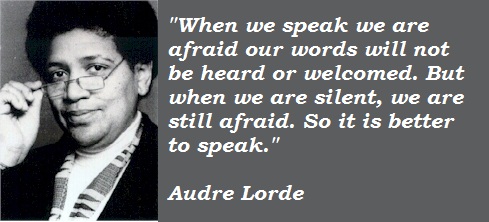


…Breast cancer was a dread secret, endured in silence and euphemized in obituaries as a “long illness.” Something about the conjuncture of “breast,” signifying sexuality and nurturance, and that other word, suggesting the claws of a devouring crustacean, spooked almost everyone.” (Ehrenreich 45) The secrecy, surrounding breast cancer and the need for women who have had a mastectomy like Lorde to use prosthesis to “look normal and natural,” is part of the reason women who suffer from cancer cannot talk about their experiences with the emotional, mental and physical trauma and pain that comes with a cancer prognosis. (Lorde 71) The culture of silence around the experiences of cancer patients breeds an environment in which women are no longer themselves but their illness as Ehrenreich wrote “Where I once was—not a commanding presence perhaps but nonetheless a standard assemblage of flesh and words and gesture—‘there is a cancer.’ I have been replaced by it, is the surgeon’s implication. This is what I am now, medically speaking.” (Ehrenreich 44)

To be sure, the experiences of cancer patients are not all the same, nor will they ever be.  Audre Lorde’s experience with cancer as a Black Lesbian Feminist will never be the same as Barbara Ehrenreich’s, who is a white woman. The lack of language and opportunity cancer patients have in expressing their pain can be chalked up to “they didn’t say anything”, however, to do this is a grave injustice to not only patients but to everyone in general, because an environment is created in which we cannot discuss the most basic of human interactions: our feelings. Joanna Brouke wrote in “How to Talk about Pain” that “…pain was emptied of positive value. Rather than being passively endured, pain became an “enemy” to be fought and ultimately defeated.” (Brouke) The establishment of pain as the enemy also establishes people who talk of their pain as the enemy because they are seen as complainers, this is the society in which we are living.

In conclusion, we need to value emotions; valuing all emotions, and embracing the fact people do experience pain and need language to describe how they are experiencing their pain we can do justice not just for cancer patients but to create a healthier society in which all emotions are valued.


Work Cited
Brouke, Joanna. “How to Talk about Pain”
Ehrenreich, Barbara. 2001. "Welcome to Cancerland." Harper's Magazine, November 1, 43.
Lorde, Audre. 1980. Theœ Cancer Journals. 2. ed. ed. San Francisco: Aunt Lute Books.
Woolf, Virginia. 2002. On being Ill. Ashfield, Mass: Paris Press.


Reclaiming Femininity


The female anatomy is subjected to changing ideologies with age and experience. Starting at a young age, through the development of attachment to breast, breast feeding and other forms of interaction the attachment to breast is formed. The intimacy of not only breastfeeding, but the recollection of the experience with breast being an object of sexual desire, but a method or platform that displays personal life experiences. Outsiders who see women that have undergone breast removal, for various reasons, may feel uneasy due to society’s association with breast since they are sexualized. The experience extends beyond the individual, and may affect those closely related such as family members, medical doctors, and significant others. Experiences with breast may shape an individual, but in no way signifies being a women. By creating a parallel between the experiences of Audre Lorde and other individuals regarding the saliency of their breast beyond cancer, important conversations can occur to change societal perceptions of breast and there link to womanhood.

“Each woman responds to the crisis that breast cancer brings to her life out of a whole pattern, which is the design of who she is and how her life has been lived.” The quote that starts off Audrey Lorde’s, The Cancer Journals, provides context to how breast cancer may shape a woman’s life, as breast creates an unnerving parallel of thought to the circumstances surrounding a woman’s life through her breast. The notion of breast cancer creating a recollection of memories, proves the significance of breast beyond a person's life to create the woman they have become today. Today women who have gone through mastectomy are becoming more empowered with their feminine nature even though many societies and cultures view breast as a sign of womanhood. Through increased agency and promotion of self image, woman are starting to reclaim their bodies from the perception creates in our heteropatriarchal society and becoming more comfortable with the idea of being a woman who has gone through the medical removal of breast.


As quoted by Ms. Marcou:

Ms. Marcou, 59, who had a mastectomy 15 years ago, said: "People used to hide in the closet. Individual women still tussle with their body because it's so valued in society. Every woman who goes through this will wonder about her femininity and sexuality. But it comes down to this: 'Your femininity is not determined by whether or not you have breasts.”

Ms. Marcou describes an experience all too familiar in today’s society; women feeling uncomfortable with their body due to societal perception of perfection and beauty. Society’s expectations are particularly taxing on those who have undergone a mastectomy, since breast are portrayed as a definition of beauty in modern day society. The expectation of society, in particular for women after breast removal, removes agency from women who have undergone a mastectomy due to the emphasis of breast in modern culture. As a culture that links breast with reproduction, society removes the stories, character, and emotion tied into the physical being of breast.  Women who lose their breast face callow individuals asserting “normal”  females either use prosthetics or create the image of having breast. Through the prosthesis, it creates the conversation of removing the experience of pain from breast cancer survivors. Moreover, removing the stories surrounding breast cancer and its greater impact to females globally take away from the experience of breast removal. Audrey Lorde also speaks to these issue through the following quote:

"When other one-breasted women hide behind the mask of prosthesis or reconstruction, I find little support in the broader female environment for my rejection for what feels like a cosmetic sham," [..] The social and economic discrimination practiced against women who have breast cancer is not diminished by pretending that mastectomies do not exist."

By creating an environment that does not acknowledge a woman's pain, and instead attempts to hide it through diminishing women who decide to display the story of strife, courage, and perseverance. Displaying their mastectomy in a way that does not subject them to societies standards of beauty, by reclaiming their bodies and showing that this is something that exist.

Bringing to light the issues surrounding breast and providing women with agency who have gone through a mastectomy the ability to affirm, survive, and share their strength and stories returns empowerment and agency to women. Breaking down the societal perceptions of breast being sexualized, and acknowledging the women and the stories and the power it gives to each woman who decides to display her body without judgement, will lead to greater awareness of breast cancer and strengthening all individuals who have had or may have breast cancer.


References
Williams, Lena. "Women Who Lose Breasts Define Their Own Femininity." The New York Times. The New York Times, 1991. Web. 03 May 2016.

Lorde, Audre. The Cancer Journals. San Francisco: Aunt Lute, 1997. Print.

Breast Cancer Survivors versus Their Breasts: Which Is More Important?

In advocating for healing within breast cancer survivors and raising awareness about breast cancer, what is most focused on? The survivors themselves or the importance of their breasts?
As breast cancer survivors, both the physical and psychological aspects of healing are a process which many struggle with. There are many support groups and organizations that reach out to breast cancer survivors in order to help them heal or raise awareness on their struggles. However, the interpretation of what successful healing is supposed to look like varies. In Audre Lorde’s book The Cancer Journals which documents her experiences before and after her mastectomy, readers are given knowledge on Lorde’s personal thoughts and feelings throughout the process of coming to terms with what was happening. As a lesbian black feminist, Lorde’s perspective and questions during her journey with cancer are not aspects often addressed or explored by organizations which seek to help breast cancer survivors. However, much of their advice and structured path of healing for survivors is easily viewed as the correct path due to its neat fit into already established norms.
In The Cancer Journals, it was seen through Lorde’s experience that the options she was given by institutions and organizations for healing mainly viewed breast cancer treatment by a mastectomy as a cosmetic issue. For example, Lorde’s encounter with the group Reach For Recovery presented the application of lambswool as a substitute for the removed breast as an important step in feeling “normal” again. Audre Lorde was clearly disgusted at this practice as a means to heal from her trauma with breast cancer, as “This prevents a woman from assessing herself in the present, and from coming to terms with the changed planes of her own body. Since these then remain alien to her, buried under prosthetic devices, she must mourn the loss of her breast in secret…” (Lorde, 57). Lorde further discusses how this alienates breast cancer survivors from each other, and encourages women to remain in a nostalgic state.
Although I am not a breast cancer survivor, nor does my reading The Cancer Journals make me an expert on Audre Lorde’s experience, it was apparent to me through Lorde’s narrative that the presented options by Reach for Recovery for settling back into life as smoothly as possible post-mastectomy created an opening for more psychological damage. As Reach For Recovery worked with the hospital, it was unsurprising for Lorde to experience a push from the hospital staff as well to begin using the prosthesis. Through Lorde’s frustrations, it seemed that prostheses were meant to integrate women without both breasts back into a society which objectifies women. Without both breasts, this objectification would be disrupted. When looking at popular sources for information on psychological healing from being a breast cancer survivor, a familiar rhetoric would present itself time and time again. On breastcancer.org when exploring the option of breast reconstruction surgery, the website states “It’s normal to feel anxious, uncertain, sad, and mournful about giving up a part of your body that was one of the hallmarks of becoming a woman: a significant part of your sexuality, what made you look good in clothes, how you might have fed your babies…Moving forward, you now have the opportunity to determine what you want to have happen next.” (breastcancer.org). Although the statement stresses the very real pain and sadness that comes post-mastectomy, it alienates certain women and is biased toward women taking certain options to “move forward”. This statement assumes that the breast cancer survivor has children, and that breasts are exclusive to women. By emphasizing breasts as “what made you look good in clothes” and being “a significant part of your sexuality”, this implies to post-mastectomy women that breast reconstruction surgery is necessary to look good in clothes and have a good sex life again. In another section of the website, there is a link to another part of the website which is titled “Prosthetic: An Alternative to Reconstruction”. This further gives women who are breast cancer survivors the idea that their sensible options are limited, as not choosing breast reconstruction surgery or a prosthetic is not an option greatly explored. Interestingly, there is also a “Going Flat: Choosing No Reconstruction” link on the breastcancer.org website. However, the rhetoric in this section of the website is also significant in impacting the way women view their breasts in much of the same way that the section on breast reconstruction surgery had. Part of the section’s introduction stated “If you've had one breast removed and feel self-conscious about looking lopsided, try going without a breast form at home. Then try running an errand or going out for coffee without your prosthesis. You’ll probably find that people don’t notice the difference, or if they do, it’s not a big deal.” (breastcancer.org). Although the website stated “…it’s not a big deal”, the statement was constructed in a way which highlights the importance of people noticing how “normal” a breast cancer survivor’s breasts are. Through this statement, it obviously is a big deal.
            This kind of rhetoric which helps establish what is valuable for women are restricting for breast cancer survivors. Other organizations such as Keep A Breast which produces the I Heart Boobies merchandise continue to bring the focus of breast cancer research and breast cancer survivors to solely their breasts. This kind of publicity, marketing, and rhetoric seems to separate the actual women from their pain by highlighting the appearance of breasts. This is most starkly portrayed by porn website Pornhub’s take on breast-cancer awareness, as it stated in a NYTimes article that Pornhub “…would donate a penny to a breast-cancer charity for every 30 views of its “big-” or “small-breast” videos.” (NYtimes.com). For women who are breast cancer survivors to feel that they are not limited in options due to the value of the appearance of their breasts, rhetoric and tactics used by (probably) well-meaning organizations must be reflected on and changed to stray away from objectifying women.


Dealing with Inconclusive Results and the Healthcare System


 In her journals Audrey Lord talks about turning voice into action. Lorde recounts her experience as one that was lonely and fearful, found some comfort in people that were in the same situation, but it often didn’t feel real. Lorde openly talks about her experience and placed her voice in her writing, which did not fit the narrative of other cancer patients. 
         Presently, I have been dealing with some health issues. There has been a persistent numbness to my left foot that doctors and the health center were not identify, until I met with a neurologist this past Monday. It was my aversion, and my tendency to be a bit of a hypochondriac, to be alarmed because my leg might suffer from nerve damage. In fact, this is the second time that I have dealt with inconclusive results from health exams and check-ups. The numbness in my leg has been diagnosed as peripheral neuropathy, something curable with the treatment to the proper nerve in my leg. Before I even had a name for my condition I had to go to several doctor and visit Med Express and even get two MIRs. I had no idea what they were looking for, it was only later I found out that they were looking for tumors both in my spine and my brain. Thankfully, they found none and there can be a cure for my leg. Throughout this whole time in the back of my head I had two thoughts: (1) medicine is expensive and (2) how come I did not know that they were looking for something more serious? In the same note, I also thought that it was my individual duty to know what the doctors would be looking for in a MRI or that I should know that problems with the spine can lead to nerve problems in the legs.

          Individualizing the duty of knowing more about our bodies onto a patient, becomes the narrative of sickness that someone is going through. The problem are the methods used to diagnose the person, or the methods to procure treatment for the person. In fact, many of the doctors that I talked to gave so little information, and only provided me with the facts or looked for answers to questions to my father who was with me in each appointment, and ignored my questions. My questions were, is it because I am a woman? Is it because I am not seen as responsible due to my age? The complete disregard to provide me with the necessary tools, where I could understand them, left me speechless. If it happened to me for something that is curable and did not have an explanation for some time, how is it for people who have very serious medical conditions? How to they get treated? In that case, Audrey Lorde’s call for voices to be heard comes into my mind. How the patients voice be heard? Through all the regulations and laws that are tied for the benefit of the patient but really do not help? What kind of action would it be required for this to change?
         Audrey Lorde talks about sickness consuming the person, and not being more than what they are sick with. In that case, would separating the person from their sickness and seeing them as people be the right step? Probably. Alienating the person from their own bodies is one of the major issues that can resurface for many patients. Welcoming the bodies, and negating stigma against how in the public spheres we perceive sickness could be another way to create action.


      The kind of activism that Audre Lorde probably talks about is the kind that speaks when others want it to be silenced. It would give voices to those who do not have it. It would create community for those who cannot find one. It would change the way our health care system work, that only benefits some. The narratives of these people would be told, and they would not have to go to countless of doctors to find an answer to what might be wrong with them. They might find a second opinion, or a third, and compare to what the others have said.
Additional resources used for this op-ed: 
1. Understanding Laboratory Tests 
2. Below I am attaching the HIPAA's condense explanation of one's right. 


References:
Lorde, Audre. The Cancer Journals. San Francisco: Aunt Lute, 1997. Print.


"A Female Outcry Against Preventable Cancers"

(Audre Lorde.  Copyright Dagmar Schultz)


CW: cancer, rape

After receiving a mastectomy for malignant breast cancer, Audre Lorde mourns the loss of her right breast.  She writes in The Cancer Journals, most ardently, "I alone own my feelings. I can never lose [the feeling of her breast] because I own it, because it comes out of myself" (Lorde 79).  Does Lorde claim ownership of her feelings and her body only after suffering great loss?  The knowledge that Lorde gained through her relationship with breast cancer helped her de-center fear as a way of knowing and owning her body.  Throughout The Cancer Journals, I was awed of how Lorde’s poise and strength withstood her loss.

As a scholar, I am interested in the nexus of "preventable cancers" and marginalized bodies.  When do women learn to own their bodies?  Is this ownership intuitive? Or does it need to be confronted in the wake of disempowerment or loss? Only after great physical loss, a loss of her own organ, Lorde writes that she claims the feelings of her body as her own.  Lorde then concludes The Cancer Journals saying, "I would have never chosen this path, but I am glad to be who I am, here." Does suffering a great loss help Lorde claim ownership?

Earlier in the journals, Lorde wrote that she had no real model for going through breast cancer as a "black lesbian feminist poet."  The experience of breast cancer was not necessarily generalizable to all bodies and she wondered how it would manifest on her own, but had no standard to look to.  Even today, several decades following Lorde’s journals, discussion of breast cancer is often silenced or curbed by fear.  There are pink t-shirts in memoriam and races for raise money for a cure, but are there conversations? Lorde writes that the “silencing and political repression by establishment medical journals keep vital information about breast cancer underground and away from the women whose lives it most affects” (74).  The cultural hype surrounding breast cancer seems to cluster around finding a cure and honoring women who have passed, but conversations surrounding prevention are largely silent. Why must women endure breast cancer at all?

The rhetoric of "preventable diseases" is contradictory.  On one hand, advocacy for prevention allows women to take control of their health and their bodies. Lorde hoped to empower other women in the wake of her loss, concluding that "every woman has a militant responsibility to involve herself actively in her own health" and that every woman should have fair access to information about carcinogens (75). But is empowerment enough?  Lorde also recognized that the "preventable disease" replicates a victim-blaming paradigm. Lorde discussed her own relationship with breast cancer and feelings of guilt and shame.  She revealed feelings of regret, wondering if there was anything she should have done differently to prevent the cancer.  Does the notion that breast cancer is often “preventable” blame women who are already suffering? Who can prevent cancer and who can't?

Lorde wrote that she hoped to use her journals as a point of connection for "other women of all ages, colors, and sexual identities who recognize that imposed silence about any area of our lives as a tool for separation and powerlessness" (7).  I thought about the ways that women are confronted with “preventable” violations of their own bodies and I wondered: who needs to be empowered?  Women who are suffering? Women who can circumvent suffering?  And how does personal empowerment address breast cancer as a systemic disease?

I see this same rhetoric used in the silences of rape culture. I emphasize silences, and not conversations, because similarly to breast cancer, I feel like the cultural discussion around rape culture is misaligned. However, the rhetoric surrounding rape culture centers around prevention, not healing.  It is interesting, too, that Finding A Cure for breast cancer is never about healing. It’s about clean-cut, mechanical solutions. It’s not about the process of healing from a body that has been violated. It’s about obscuring the process of healing as hard work.

Do I own my feelings and my body? I am using my own experience as a source, intentionally, to honor the personal praxis that Lorde embodies.  I am not trying to emblemize the lived experiences of violated bodies, as Lorde expertly diverts in her own narrative.  I am merely trying to echo the notion that healing is labor. Breast cancer is greater than the sum of every loss my body knows, but through Lorde's writing, I feel a solidarity.

My ownership of my body rose out of cultural silences and gaps.  I remember what it was like to wake up and not know if I had been raped.  At first, I brushed the situation off as nothing.  Rape was such a heavy word to heave. I didn’t feel comfortable claiming a word that’s so embedded in other people’s suffering.  What if I used it and I was wrong?  What if I was just exaggerating? The guilt kept me silent. How could I start a conversation when I wasn’t comfortable using language?  What else was there to say? Why was there only one word for rape when so many people suffer?

The silence got to me.  Was I raped “enough” to use the language?  I simply wanted to know.  I boated these questions over the margins of books and of Internet searches.  I looked for spectrums of rape, but everything told me that consent was clear and simple.  It didn’t feel simple to me then. 

I tried so hard to empirically know.  Could I feel it in body or my mind?  What did it feel like to wake up in a violated body?  And then I realized - I knew.  Living in a violated body was the only way I knew how to navigate the world.  My body had never been for myself and I had never claimed it.  I feel it in how Lorde simply states, “Women have been programmed to view our bodies only in terms of others, rather than how they feel to ourselves, and how we wish to use them,” (65-66). As a teenager, my body was in constant flux. I lost over fifty pounds in high school and my body always felt unfamiliar. I needed to claim my body, even if it was always changing. I needed to claim my body not to prevent instances of rape, but in order to heal.

Me and My Body: It's Complicated


My body and I have a complicated relationship. Some days I call it a love-hate relationship and some days I even question whether I truly love or hate the girl in the mirror. Love and hate are such strong words. Can I justify hating my body when I wear size S t-shirts? How can I possibly love it when my thighs rub holes through my jeans? Some days I will tell the girl in the mirror that her hair looks nice but some days she is slouchy and has too many belly rolls. Some days she has legs a mile long and on others she has eight chins. No matter how many times my past or present significant others tell me that I am beautiful, sexy, pretty, or even cute, I struggle to use these words myself in any way other than self-deprecating, sarcastic jokes. Even typing them out here brings out surprisingly strong feelings of self-doubt and vulnerability. And I know I am not alone. From my own experiences, discussions with friends and family, and stories I see on Facebook, I know that women in our culture are struggling to love their bodies. 

The most intimate relationship a woman will ever have is between herself and her body, and yet this is also the relationship in which she has the smallest voice and about which she receives the most input from all directions. Our culture is viscous in the ways in which it interferes with a woman's relationship with her body, and messaging from all sides manifests in the behaviors of women everywhere. Pale women tan their skin, while dark women bathe in bleach. Curly-haired women straighten while straight-haired women use curlers. Women are trying desperately to have the body they are told to want, not the body they have. The conflicts between the image of commercial beauty and the social messages women receive are impossible to navigate. Women and girls see clothing and makeup ads, with thin, tall, beautiful women with perfect skin and teeth. Medical centers encourage overweight women to get cosmetic weight loss surgery, and there are endless parades of diets, healthy cookbooks, pills, and programs which women need in order to be beautiful. 

There is resistance against these harmful messages of industrial beauty. There are body positivity movements, which encourage women and men of all body types to simply disregard the endless stream of beauty ideals and pressures. Many people have been properly alarmed by thinspiration and bikini bridge social trends, expressing their fears and concerns in articles such as these and these. However, the efforts of feminists and body positivity cannot silence the endless and well-funded screams of corporations who fill their pockets with the money of vulnerable women. When websites such as Anaface.com tell women specifically what is wrong with their faces, it is extremely difficult to ignore.


Caption: Fig. 5 (or, “Elon Musk’s Electric Muse”)
Websites such as Anaface teach women to hate their bodies. 
Audre Lorde's The Cancer Journals provide an interesting look into the relationship between a woman and her body. After her mastectomy, she receives many messages, both subtle and blatant, which try to dictate the way in which she feel about the new body she lives in. There is enormous pressure for her to wear a prosthetic, from nurses, members of recovery groups, and from people in her doctors' office. She writes that "with quick cosmetic reassurance, we [women] are told that our feelings are not important, our appearance is all, the sum total of self" (p. 58). Lorde does what is extremely difficult for other women to do; she does not allow the external influences she experiences to determine how she thinks about her body. She refuses to hide her missing breast in order to make "a woman-phobic world" more comfortable (p. 62). This makes those around her, not including the supportive women in her life, highly uncomfortable and anxious. She is not encouraged to love her new body the way it now is, she is told to hide the difference and pretend she is the same as she was before.

Why aren't women allowed and even encouraged to love their bodies? Seeing this mess every day, and struggling with my own perceptions of myself, I want to know the answer. I want to know why women are shoved into this competition against themselves and other women. Why are such harmful beauty ideas shoved down the throats of women? Why are women told to love themselves, but are only applauded for doing so if they look a certain way? Why is it shocking for me to read Audre Lorde's loving and gentle words about her body and her right breast? I think she is right to call this a woman-phobic world. I think each woman has a difficult task in front of her: to love her body as no one else will, despite those who would tell her to change. 


Lorde, Audre. The Cancer Journals. San Francisco: Aunt Lute, 1997. Print.
Image source: http://www.xojane.com/issues/i-tried-the-internets-top-6-body-shaming-challenges

Is Awareness Now a Business?

“I want to write about the pain. The pain of waking up in the recovery room which is worsened by the immediate sense of loss. Of going in and out of pain shots. Of the correct position for my arm to drain...I want to write of the pain I am feeling right now, of the lukewarm tears that will not stop coming from my eyes - for what? For my lost breast? For the lost me? And which was that again anyway? For the death I don’t know how to postpone? Or how to meet elegantly? I’m so tired of all this. I want to be the person I used to be, the real me. I feel sometimes that it’s all a dream and surely I’m about to wake up now.” -Audre Lorde, The Cancer Journals


There’s no denying that Audre Lorde told us how it was.


Ever since the year 2000, my family has been active members of the Pittsburgh East Relay for Life, due to my mom working with oncology and then moving on to hospice care. She was around cancer patients around the clock and thought getting involved with the American Cancer Society (ACS) would be great to the patients and the overall cause alike. Since then, our participation in Relay for Life  has grown, with her and I taking on leadership positions, as well as getting involved with other events (including other location’s Relay for Life and the Susan G. Komen Race for a Cure). However, starting around 2013/2014, we noticed something shift in the foundations of these fundraising events. American Cancer Society staff partners (who we had worked with for years and developed great relationships with) were being let go and replaced by new hires, who were seemingly focused on more of the business side of Relay for Life, rather than overall community aspect. This brought tension to the events - but in different ways than one would expect. Not necessarily between the ACS staff partners, but between the committee members. Debacles ensued pertaining to money goals not met, low community turn outs, and things not running as smoothly as planned. My question is: isn’t all of that besides the point? Isn’t it about overall awareness and showing cancer survivors your support?
pink products
My theory for this shift is the yearly growing “businesses” such as Breast Cancer Awareness month. Starting out as something great - this has turned into a total cash grab. Marie Claire, labeled as a “women’s news source,” tells: “This month, an awareness-minded consumer can buy almost any knickknack or household item in pink — from lint brushes and shoelaces to earbuds and Snuggies. If she happens to be in an American Airlines Admirals Club, she can snack on pink cookies while drinking pink champagne.” Why has a month dedicated to awareness turned into something in which is being capitalized upon? Additionally, organizations such as ACS and Susan G. Komen constantly create pictures with cancer survivors (or models) showing how they’re happy and “fighting the battle.” However, as Audre Lorde explained earlier, is it really that glamorous? Why don't they really tell us how it is?

I don’t wish to leave on a sour note, as I do believe these organizations do help, it’s just that the way they’ve been going about things lately has been a little iffy in my eyes. But they do in fact bring people together - and for someone going through something as awful as cancer, support can be the best ally in fighting the battle.


“I have found that battling despair does not mean closing my eyes to the enormity of the tasks of effecting change, nor ignoring the strength and the barbarity of the forces aligned against us. It means teaching, surviving and fighting with the most important resource I have, myself, and taking joy in that battle. It means, for me, recognizing the enemy outside, and the enemy within, and knowing that my work is part of a continuum of women’s work, of reclaiming this earth and our power, and knowing that this work did not begin with my birth nor will it end with my death. And it means knowing that within this continuum, my life and my love and my work has particular power and meaning relative to others.” -Audre Lorde, The Cancer Journals


---
Works Cited:
"The Big Business of Breast Cancer." Marie Claire. Hearst Communications, Inc., 14 Sept. 2011. Web. 03 May 2016.
Lorde, Audre. The Cancer Journals. San Francisco: Aunt Lute, 1997. Print.

Images:
http://www.marieclaire.com/politics/news/a6506/breast-cancer-business-scams/
http://solesistas.co.za/wp-content/uploads/2013/02/breast-cancer-ad-2.jpg