 |
| Pain Scale. Google Images |
My earliest memory of pain and
the first time I played in snow both occurred on the same day. I was eight
years old and it was an ordinary Saturday; I woke up and started to clean up my
room. I looked out the window and saw white fluff falling from the sky. It took
a minute for me to register that what I was seeing was snow, not fluff. I
finish my chores and bundled up to play in the snow. As a recent immigrant from
Jamaica I was bundled up like the Michelin Man; being a child I removed my
gloves. Needless to say after half an hour I could no longer feel my finger but
the joy of having my first snow fight and making my first snow angel was more
important. An hour later, I went inside and sat in front of the heater, as my
fingers warmed up I experienced excruciating pain. I cried out and my aunt kept
asking me “What is wrong?” all I could reply was “It hurts.” I like many others
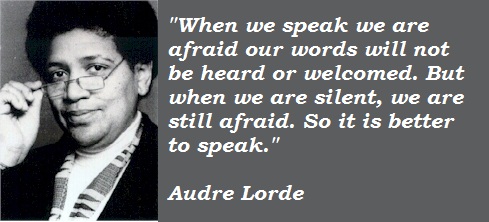
have no words to express pain; we also have trouble talking about pain. Audre
Lorde is one of few who can articulate pain.
Lorde writes in The Cancer Journals “I want
to write about pain…of going in and out of pain…I want to write of the pain I
am feeling right now…” (Lorde 23). Lorde writes in 1978 after the mastectomy of
her breast to combat breast cancer. Forty-eight years earlier Virginia Woolf,
who was afflicted with bipolar disorder wrote about illness in
her work On Being Ill, and the lack of vocabulary to
describe illness and the pain that inevitably comes with illness.
Both Lorde and Woolf had a way with words. Both experience their
illness and pain differently but both used their gift with words to articulate
for others the lack of language we have surrounding pain and the culture around
not expressing our pain.
As a breast cancer survivor when
she wrote The Cancer Journals, Lorde experienced her
illness in a world where women with breast cancer were and still are
considered "warriors." (Lorde 62) Applying war as the metaphor for the
battle against breast cancer, also applies the characteristics of
a warrior onto women who have breast cancer. A warrior as defined by google is
"a brave or experienced solider or fighter." A solider or a
fighter has no room to not be brave, to show fear or express their pain. They
are to be tough, emotionless, protectors and role models that everyone can look
up to. When the term warrior is applied to women with breast cancer we are
essentially telling these women that they cannot be human, they cannot show
their vulnerability at their most vulnerable time; a time where they
need the support of their friends and loved ones. Instead they are the one who
has to protect the feelings of their loved ones and not be the cancer patient who
needs sympathy.
Barbara Ehrenreich's Welcome to Cancerland: A Mammogram leads to a Cult of Pink
Kitsch, explores the path a
cancer patient is not only put on but expected to follow once they receive their
positive diagnosis. Like Lorde who woke up in a cold recovery room after her mastectomy,
Ehrenreich experienced the being left in an exam room while doctors and
pathologist study her mammogram scan, and retook scans without giving her any
information. (Enhrenreich 43) Critiques of
the happy go lucky image breast cancer patients are supposed to have at all
times, is few and far in between. Lorde and Ehrenreich are critical of the lack
of support and space for breast cancer patients to truly express the full range
of their emotions: the anger, frustration, sadness and pain (both
emotional and physical).
“…Breast cancer was a dread secret,
endured in silence and euphemized in obituaries as a “long illness.” Something
about the conjuncture of “breast,” signifying sexuality and nurturance, and
that other word, suggesting the claws of a devouring crustacean, spooked almost
everyone.” (Ehrenreich 45) The secrecy, surrounding breast cancer and the need
for women who have had a mastectomy like Lorde to use prosthesis to “look
normal and natural,” is part of the reason women who suffer from cancer cannot
talk about their experiences with the emotional, mental and physical trauma and
pain that comes with a cancer prognosis. (Lorde 71) The culture of silence
around the experiences of cancer patients breeds an environment in which women
are no longer themselves but their illness as Ehrenreich wrote “Where I once was—not a commanding presence
perhaps but nonetheless a standard assemblage of flesh and words and gesture—‘there
is a cancer.’ I have been replaced by it, is the surgeon’s implication. This is
what I am now, medically speaking.” (Ehrenreich 44)
To be
sure, the experiences of cancer patients are not all the same, nor will they ever
be. Audre Lorde’s experience with cancer
as a Black Lesbian Feminist will never be the same as Barbara Ehrenreich’s, who
is a white woman. The lack of language and opportunity cancer patients have in expressing
their pain can be chalked up to “they didn’t say anything”, however, to do this
is a grave injustice to not only patients but to everyone in general, because an
environment is created in which we cannot discuss the most basic of human
interactions: our feelings. Joanna Brouke wrote in “How to Talk about Pain”
that “…pain was
emptied of positive value. Rather than being passively endured, pain became an
“enemy” to be fought and ultimately defeated.” (Brouke) The
establishment of pain as the enemy also establishes people who talk of their
pain as the enemy because they are seen as complainers, this is the society in
which we are living.
In conclusion,
we need to value emotions; valuing all emotions, and embracing the fact people do
experience pain and need language to describe how they are experiencing their
pain we can do justice not just for cancer patients but to create a healthier society
in which all emotions are valued.
Work Cited
Brouke, Joanna. “How to Talk about Pain”
Ehrenreich,
Barbara. 2001. "Welcome to Cancerland." Harper's
Magazine, November 1, 43.
Lorde,
Audre. 1980. Theœ Cancer Journals. 2. ed. ed. San Francisco: Aunt
Lute Books.
Woolf,
Virginia. 2002. On being Ill. Ashfield, Mass: Paris
Press.

No comments:
Post a Comment