Friday, April 15, 2016

Another Dimension of Labor: The Gendered Aspects of Emotional Labor Within Sex Work

Another Dimension of Labor:
The Gendered Aspects of Emotional Labor Within Sex Work
By: Rachael Robertson


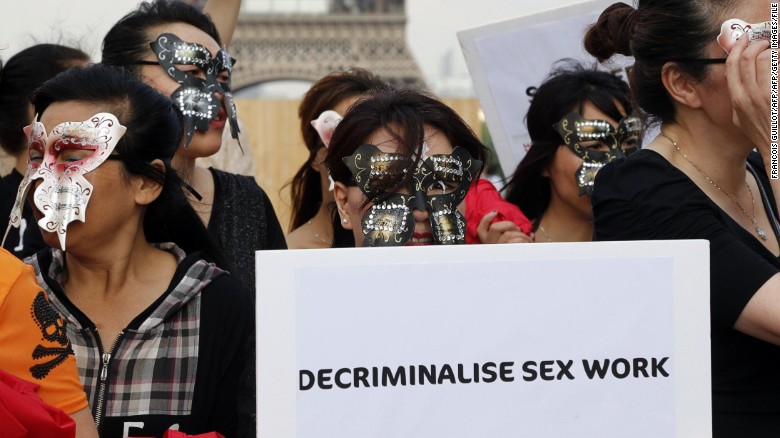
http://d1o2xrel38nv1n.cloudfront.net/files/2014/09/sex-work.jpg 
Photo:  A rally advocating for recognizing sex work as work (Source: http://d1o2xrel38nv1n.cloudfront.net/files/2014/09/sex-work.jpg)

Laura Maria Augustin’s book “Sex at the Margins” relies on the assertion that sex work is labor (Augustin 2007).  For her, the rhetoric that argues otherwise misses and devalues much of what sex work actually entails:  the act of sex itself, creating intimacy, and emotional management.  Much of the chapter explains the connection between sex work and labor, as well as reflecting on the ways in which people frame it to ignore its value as labor.  However, she also explores how sex work can manifest itself in many kinds of labor.  I was particularly interested in the heavily gendered labor that sex workers do in regards to emotional management as being an even more hidden and assumed aspect of sex work.  While not all sex workers are women, this labor is part of the unpaid work that women do in addition to labor that is traditionally, culturally, and structurally recognized and valued.

In order to do sex work, the conditions for sex that appeals to clients must be created by sex workers.  Creating the conditions for an emotional space that clients feel is appropriate for sex is also labor intensive in addition to the work of sex itself.  The conversations leading up to sex, the counseling of client’s problems, and ensuring that clients feel emotionally stable and satisfied are all part of the emotional labor that is part of sex work.  To illustrate the many ways that sex workers use emotional labor to negotiate emotional needs (and cultural needs, particularly within migrant sex labor), Augustin used quotes from sex workers themselves to show the different ways that their work involved far more than simply performing sex.  For instance within migrant sex work specifically, Augustin notes that, “many service-providers, as well as their clients, resist being labelled as objects of sex tourism when sexual contact is only one service among many” (p. 84).  Speaking with their clients - many of whom are practically strangers -in meaningful and adapted ways is time intensive and requires emotional energy that often is not accounted for or actively noticed.  Despite how pervasive it is, emotional labor is elusively invisible and disproportionately expected from women.

In order to recognize the emotional labor done by sex workers as another gendered part of their profession, it is important to remember that both in sex work and in sex generally,  intimacy and a certain emotional environment do not occur naturally.   These conditions are created by the people participating in sex, and often the work to create these conditions is unbalanced.  In heterosexual sex, the role of emotional management and filtering is done by the woman.  Within sex work, this labor is done by the sex worker and this work is feminized regardless of the gender of those participating.  The expectations for women to perform invisible emotional labor are so deeply entrenched that often women are characterized as “naturally” better at empathy and intuition.  This assumption dually acts to deflect from the work it takes for people to be empathetic and intuitive (as well as other imbalanced and draining emotions) and excuses men from having to contribute to this labor.  In a lot of ways women are more empathetic, but because we are conditioned into learning it and expected to provide this emotional labor rather than having an inherent disposition for it.

A recent article in The Huffington Post written by Christine Hutchison, a feminist and experienced therapist, talks about the emotional labor of women.  She quotes the sentiments of women who are frustrated by the men in their lives, who feel expected to make sacrifices for others, who are emotionally exhausted, and who express feelings of being undervalued.  She has seen how the frustration of not having their emotional needs taken care of while being expected to absorb, filter, and categorize the feelings of other people result in utter emotional exhaustion.  While this sentiment was common among women generally, Hutchison talks about how sex workers explicitly have expressed how much of sex work is emotional labor; “These women talked about how they get compensated for their sexual labor, but a huge part of their job is emotional work (listening, validating, pretending to feel something for the sake of the other), which is assumed by the male clients to be given for free.” (Hutchison 2016).  Male clients expect to feel good emotionally in addition to being pleased sexually while only paying for the latter half of the service.  These specific sex workers echo part of what Augustin advocates for in her book: to recognize that sex work is undeniably labor and that emotional labor is a huge part of it.  Hutchison gets to the core of this issue when she writes that, “we as a society continue to devalue emotional labor economically, and ignore the ways it is gendered” (Hutchison 2016).  For sex work, we see this devaluing in the assumptions about what constitutes sex work itself and the expectations that are held for sex workers.  These assumptions and expectations reflect broader and often unspoken roles we expect women to fill and services for them to provide, whether it is for payment or not.  


Works Cited:
Augustin, Laura Maria. (2007).  Sex at the margins: Migration, labour markets and the rescue industry.  New York:  Zed Books.
Hutchison, Christine.  (2016, April 6). Why women are tired:  The price of unpaid emotional labor.  The Huffington Post.  Retrieved from http://www.huffingtonpost.com/psyched-in-san-francisco/why-women-are-tired-the-p_b_9619732.html

Who assigns agency? Sex Work and How It Can Move Forward

Amnesty International Votes to Decriminalise Sex Work, Paris, 2015 
Early this week, I saw a screening about the documentary film Not My Life a film made to raise awareness about human trafficking. In that film they showed much more than just one side of human trafficking. It was also about children, who were sold and enslaved because of different reasons.
            One of the main reasons was poverty, a systemic issue that might be one source of inequality all over the world.  One segment of the film was about sex trafficking and it talked about who were the people who were most at risk.  However one of the lines that most resonated with me was the idea of human trafficked women and their lack of agency. Later in cla
ss, importantly the idea of who has agency and assigning agency.
            It is true that women especially that are trafficked and are forced into sex work do not have agency. They are women that were forced to sell their bodies due to debts, or were tricked into sex work. However seeing sex work just as forced sex work, or an outcome of the trafficking of women for sex work and as the victim of structural violence because of the sex work are the images (although true images) that are not letting sex work being recognized as care work. Laura Maria Agustin writes about this in her piece Sex in The Margins, the space where women who cannot move forward if they create their own agency, partly because of the horrible acts of a human committing to another—human trafficking.
            The assigning of agency to me, it would seem that one that is assigned by the individuals themselves. It is a tricky word to talk about throughout topics that have been heavily divided, as right and wrong and those who can have agency and those do not. Through the stigma of sex work and the patriarchy and the questions of who is being exploited, sex workers and their rights will not become recognized as care work if the stigma and misconception continues. In her writing Agustin herself asks and the reader how it can still be an issue when so much about sex has been normalized like strip clubs, peek shows, porn etc.  So what really makes the idea of sex work so abnormal and stigmatized? Is it that the woman is actually choosing to be part of the care work? Or is it that the person proactively created agency for herself? Probably a combination of both.   Agustin uses Arlie Hoschild’s theories of emotional labor to prove her point that sex work is care work. That the individuals that are acting out of their own accord are doing their own level of emotional and caring work that is needed when they are being solicited and paid for sex.  Agustin continues, “sex workers often perform their own sexual arousal and orgasms for clients who feel more excited and gratified if they believe that workers are, they also act out flirting, counseling, and diplomacy” so sex work – care work is so much more than just the negative connotations that have been assigned to it.
            In that sense, for the sex work as care work to become even more forward, productive and caring to those who are part of the sex industry. I want to focus in the growing number of young women that are part of it, and also pay their college tuition with that support. Instead of being sensationalized, crafted and viewed as a mischievous sex crazed girl but instead as someone who is designing their own path to pay for education (which the costs now seem to be unattainable for some). It would be more beneficial for the stigmatization to end, and to understand that it is not immoral but their own choice. It would be the time to understand that they have assigned their own agency themselves.  By protecting the individuals who are making these choices through campaigns that work towards the destigmatize of sex work, and by being recognized by larger groups of sex work advocates would be the step towards proactive change to make the environment safer for women who are in that line of care work. In the article that I have attached by VICE the stories of young women are similar in that finding a community and support taught them about their line of work and they did not feel as alienated. Creating these spaces is extremely important. 

            Just like Agustin reassured in her piece, sex work and its many components, is care work. Moving towards a path that accepts this and the agency of women who chose it, would create a much better environment for the workers. They will feel less ostracized and the stigma would be removed. At the same time one must not forget that all of the individuals in sex work might not be in it willingly or at their own accord. In addition it it is not my intention to diminish their stories and their struggles. However by creating a much safer environment for sex workers, unlike France where paying for sex has been banned, perhaps it can also create opportunities for those who did not go into sex work or care work at their own accord find support in these spaces where sex work can be free of stigma. It would open the doors to those who have felt the cold shoulder of society; it would help the victims that might have not gotten into sex work willingly. It would be a step forward for those who want their own agency.
Agustín, Laura María. "A World of Services." Sex at the Margins: Migration, Labour Markets and the Rescue Industry. London: Zed, 2007. 53-89. Print.
NotMyLife.org

Sex Acts and the Stigma that Society Holds on Sex Labor Workers

    Augustin explains how there are two perceptions about sex 1. that sex is incomparable to anything else and 2. is that it is comparable. There is a huge difference between sex labor and sex trafficking, and that is something that people don't realize. I know that I thought all work related to sex the person was forced into it, but that isn't always the case, some women enjoy being a part of the sex world. Also what I have noticed from the reading is that some women from international countries believe that sex is making love and spreading love, also it isn't just about sex, it could be relieving stress from the individual also it might have some health benefits. There are many other ways a sex worker can help because they don't always have to have sex, because the individual might just want someone to listen to them and their problems, which is similar to a psychiatrist. Sex workers are also performers who sometime fake orgasms and perform their own sexual arousals for their clients. For most sex workers it is all an act, like any other job. 

"Hochschild explains that concept of emotional labour in her study of flight attendants, arguing that their ability to handle the job is determined by 'control over the conditions and terms of the exploitation of [their] emotional resources.. ( Augustin pg 61).”
This is also another example of how sex workers should be evenly compared to other workers and not discriminated or looked down upon because they do something that is not talked about or perceived as slutty. 


Sex labor has been a controversial topic within the international system. There are many different aspects to Sex work. There is also the debate of whether it has any moral aspects. Some women do sex labor to help support their families because that is the only way of supporting it or getting fast money and better pay than minimum wage. Also many people from other countries believe that sex labor is okay and there is nothing wrong with it, they just that it is giving out love. A sex worker from a different country explained how men from America just want someone to listen to them and to have an emotional connection to them as well as comfort that they might not get that attention back at home. It may even go vice versa because as society fails to point out that there are also men who work as sex laborers.

Honestly, I have only had one thought about sex labor that it was a bad thing until i read more into it. I just though it was human trafficking and people kidnapping children, women and even men. I think that most people don't understand that people there is a whole other side to the sex labor field.

There is so much judgment within the sex world, most people don't like to openly talk about it and if you do then you are looked down at. Sex is a natural but what society has pressured us to think is that it is something dirty. I believe that it goes down to the educational system and how they make sex seem like a bad thing. Except when there is this obvious thing when the guy is praised for having many sexual partners and the girl is shamed. Even when I was in High School and I heard about how girls would have sex with one guy and I would completely change my thoughts about them, but then when I heard about the guy, I would just be like “Oh that's just a guy thing.” Which is not something that people should grow up thinking, but its just embedded in a lot of peoples mind that only women are the ones selling their bodies. 


The stigma on sex labor is that it is basically a bad thing that people sell themselves for money. It also isn’t talked about much due to the thoughts that society has put onto it and how it is inappropriate for a regular conversation. Many people don’t accept the fact that it is natural and just like any other job.  It also has many ways of providing people with their services. If people were to get this topic talking as a regular conversation then people would gain more knowledge about sex.

Do Women Really Have Agency over Their Bodies?


From a very young age, women are exposed to the art of seduction. Whether it is dolls that possess impossible body part size ratios or media advertisements using sex as a marketing tool, seduction is everywhere in the public atmosphere. With media as a major influence, girls grow up to fit the standard of a sexy seductress, and boys grow up expecting girls to act that way. With sex as such a prominent part of the world, it is astounding how silenced it is in common conversation. These contrasting ways in which sexuality is viewed produce a severe double standard for the agency a woman has over her body.
Views on agency can come from many parts of a person’s life, such as religion, culture, media, family values, or what is learned in a college seminar. Traditional conservative values insist on women suppressing their sexuality. The curves they possess must be hidden away from the public eye and their sexual urges must be ignored, only exposed to the man with whom they will one day be married and conceive children. In the general public point of view, women are supposed to be seductive and sexy, appealing to everyone they encounter. They are held to standards where they should dress to show off their bodies, yet only have sexual encounters in their serious romantic relationships. They should be using birth control mechanisms such as condoms or the pill so they don’t reproduce before they are ready. Although there are more freedoms in the agency a woman may have with her body according to the general public, she is still not given complete agency because some of her bodily rights are denied to her.
If women truly had complete agency over their bodies, they would be able to breastfeed in public without stares or discomfort surrounding them. They would be able to go out in public each day not wearing a bra or styling their hair and makeup without the worry that they will be negatively viewed. They would be able to openly talk about bodily functions and their sexuality without being ostracized for lewd conversation. They would be able to legally utilize their bodies to make money, working in the sex industry, without the risk of being thrown in jail for taking part in commercialized sex.
In feminist, anti-capitalist writer Laura Agustín’s blog post for Jacobin Magazine, “Sex as Work and Sex Work,” accessible at this web link, https://www.jacobinmag.com/2012/05/sex-as-work-and-sex-work/, she explains how a fundamental difference between commercial and non-commercial sex cannot be assumed. She states how in a sexual encounter, for both parties to receive pleasure from the experience, both individuals must put in work. Sexual experiences cannot be measured on a scale of equality because everyone’s body is different and everyone experiences pleasure in a different way. In Agustín’s book Sex at the Margins, she illustrates how sex workers provide a care service to their clients, acting as a lover, a listener, and an outlet for frustrations, sexual or otherwise. Exchanging sex for money is work in the same way that any other personal service provided is work. Refusing to legalize sex work is denying female, as well as male and androgynous, sex workers the right to have complete agency over their bodies and receive payment for their work in a safe, equal work environment.
The illegalization of sex work not only strips women of their rights to employ their bodies and make money off of the care services they provide, but it goes one step further in refusing them full agency by creating dangerous work conditions in the sex industry for the already vulnerable workers. The sex industry is a part of an invisible economy, as the majority of sex workers are paid underground. This economy encompasses many businesses outside of just the workers and managers in the sex industry, including, but not limited to, hotels, cab drivers, bartenders, phone companies, the tourism industry, and the film industry. With such strong roots in the economy, sex work is here to stay, legal or not. This being the case, the wellbeing of sex workers should be prioritized. It is imperative that women be legally granted full agency over their bodies and given safe working conditions, as well as full health benefits due to the frequent exposure to infectious diseases experienced by care workers. It is time for women to stop hiding their bodies and sexuality behind the double standards surrounding sexuality that are imposed upon them, and reclaim the full agency that they deserve.


References:

Agustín, Laura. Sex at the Margins. London: Zed Books, 2007. Print.

Agustín, Laura. “Sex as Work and Sex Work.” Jacobin Magazine. 16 May 2012. Web. 14 April
2016.

Elliott, Maya. “A Crime of Conscience: What We Can Learn from Jennifer Lawrence.” Her
Campus. 09 Oct. 2014. Web. 14 April 2016.

If only 'loverboys' actually loved...

   
http://thesamaritanwomen.org/wp-content/uploads/2014/11/141017-not-for-sale-loyola-prssa.jpg

     Sex trafficking is a concept that I was not introduced to until I arrived at college.  Maybe a news segment would appear on the television at home or a documentary, but my father would change the channel.  He did not believe that this was something that I needed to be exposed to at an early age.  As I read through Kara's Sex Trafficking and learn more about the many horrors of sex trafficking I realize why my father felt the need to keep it from me.  While reading I could not help but feel humble as ever about where I am at in my life and the privilege that I have. Fear was instilled in me.  Fear for people who have to experience this in their lives.  My father was able to change the channel because this was something he did not think I was ready to take in, but people who are coerced into sex trafficking do not have other options.  It is scary. It is intense.  It is real.  Now although I definitely disagree with Kara's approach to getting his information (acting as a client to be alone with women who had been forced into sex work),  his writing did help me to better understand sex trafficking.  In my writing I would like to use Kara's piece and focus on how people are coerced into the system. 
    The first coercive tactic that Kara spoke of was "sale by family".  Families will be extremely poor and have nowhere else to look for money.  The slave traders feed off of the desperation that these families are struggling with.  "Slave traders sniff out the most despondent individuals and make job offers for a child in exchange for a payment that might be as little as twenty or thiry dollars." (Kara, 2009).  Kara goes on to explain how some families will sell their children out of greed.  They most likely have enough money to survive, but could just use more.  I read an article titled, The Women Who Sold Their Daughters into Sex Slavery, that talked about mother's who sold their daughters into sex slavery and also shared the daughter's experiences.  We learn about a girl named Kieu who was sold by her mother for her virginity at the age of 12 and repeatedly sold by her mother for years to come.  "She was kept there for three days, raped by three to six men a day. When she returned home, her mother sent her away for stints in two other brothels, including one 400 kilometers away on the Thai border. When she learned her mother was planning to sell her again, this time for a six-month stretch, she realized she needed to flee her home." (CNN, 2013).  Her mother showed little remorse for her actions and said she only did it to pay off debts that she had.  She said that she had no other choice.
     Another way that sex traffickers aquire workers is through abduction.  It is not a tactic that is commonly used, but it does still happen.  Kara talks of women being abducted and sold time and time again to repay "debts".  These are often times debts that were aquired by other people, but these women have to work to repay them.  After they work off their debts to one trader they are often times traded to pay off new debts that they have unknowingly aquired.
    The idea of "loverboys" is one that I was unfamiliar with prior to taking a women's gender and sexuality studies course at Allegheny.  This term ignites a sense of sadness in me.  ""Loverboys" are agents who approach attractive and vulnerable young girls, offering them undying love, treating them to extravagant gifts, and seducing them to migrate to a rich country where they can build a life together". (Kara, 2009). After being promised all of this and accepting it the girl will be sent away to the new place that she will live and is normally picked up by either a brothel owner or a slave trader.  These women and young girls are promised these ideas of an amazing life which they could never get on their own based on their living circumstances.  
    While I read through Sex Trafficking an overwhelming feeling of helplessness came over me.  At the end of the piece Kara provides a set of options of what you can do to "help", but I did not appreciate them because he is basically trying to promote his book by telling people who read it to have other people read it.  I feel as though more people should be aware of the horrors of Sex Trafficking globally.  I am unsure of how to get the word out, but I encourage everyone to look more into it more and try and come up with ways to spread awareness.

References: 
 'The women who sold their daughters into sex slavery. (n.d.). Retrieved April 14, 2016, from http://www.cnn.com/interactive/2013/12/world/cambodia-child-sex-trade/ 
Kara, S. Sex Trafficking: Inside the Business of Modern Slavery (Columbia University Press, New York, 2009).

Prevention of Sex Trafficking: Getting to the Roots of the Cliff

Recently, during class discussion, I have become aware of the widespread sex labor debate and the vast sex industry. We have discussed both voluntary and involuntary sex labor. I believe that the coercion and exploitation involved in involuntary sex work, including sex trafficking, makes this the area most in need of urgent attention and intervention. The trafficking of humans for the sex industry occurs between and within all countries. Often, it is women and young girls that are targeted and in the highest demand. The International Labor Organization estimates that 4.5 million people are in forced sexual exploitation globally (International Labour Organization, 2012), while the Polaris Project estimates that this figure is closer to 20.9 million global victims (Polaris, n.d.). The fluidity and resourcefulness of the sex trafficking industry makes it extremely difficult to make significant strides against this heinous aspect of human culture. Many proposals have been made which try to address and hinder various aspects of sex trafficking, however it is clear from global trends that minimal systemic progress has been made (Smith, 2011). Efforts to stop sex trafficking have included trying to create stricter laws, create harsher penalties for traffickers, create awareness, and many others (Examples here and here and here). As Kara outlines, sex trafficking involves the acquisition, movement, and exploitation of victims through a variety of means (CITE). I believe that intervention early in the trafficking process will be the most effective, since this will also reduce activity at later points.
Consider Dr Camara Jones' cliff of good health analogy, in which three points of intervention exist that correlate to the three stages of intervention. Placing emergency care services at the bottom of the cliff is tertiary prevention, installing a net or trampoline on the cliff face to catch
those who fall is secondary prevention, and putting up a fence at the top of the cliff to keep people away from the treacherous danger is primary prevention. Finally, she discusses how moving communities away from the cliff entirely would be akin to addressing the social determinants of health for the issue in question. I believe that this framework can be used to fight global sex trafficking. If one were trying to discuss sex trafficking in terms of prevention, interventions during acquisition, movement, and exploitation would be primary, secondary, and tertiary prevention respectively. While secondary and tertiary prevention are necessary and effective means of dealing with an issue, successful, thorough, and effective primary prevention can in time render them unnecessary. In time and with enormous effort, primary prevention can also be made obsolete by the social determinants of health that contribute to the health outcome.
Conditions of poverty are extremely contributory in making people vulnerable to sex trafficking, pushing them closer to the hypothetical cliff. It is much easier for traffickers to acquire, transport, and exploit people in poverty. For example, it is common for families in poverty to sell their children to people claiming to be able to take them to cities and teach them trades from which they can send money back to their families (Kara, p. 8). Individuals without financial security are also more likely to consider and pursue the obviously risky offers made by traffickers, such as false job offers or marriage arrangements (Kara, p. 7-9). Poor people are much more transient than those with financial means, and they are less likely to be missed or followed up with. The harsh conditions of poverty do not create a system in which communities are monitored and protected. Finally, the exploitation of trafficked victims often involves financial dependence or debts which can never be repaid. The sex industry is a business, and individuals in poverty may be used to working in extreme and intolerable conditions for little or no pay. This makes them ideal targets. Despite the clear link between poverty and sex trafficking, it is much easier said than done to reduce or eliminate poverty in order to prevent trafficking. 
It is easy to be discouraged by the enormity of the challenge to fight the sex trafficking industry. Efforts must be targeted and coordinated to have the greatest impact in the most effective way.  Focusing on social conditions and structures that contribute to all aspects of sex trafficking would be preferential to trying to save trafficking victims after they have been acquired, transported, and exploited. I believe that one of the approaches to solving this deeply rooted systemic issue must be education. Education of women and girls can empower them, help them to escape poverty, and can offer them with better employment options, which reduces the desperation that traffickers exploit (Narayan-Parker, 2002; Roberts, 2003). Men and women can be educated about the sex trafficking industry and how to recognize attempts to acquire victims, as well as how to recognize existing victims. Resources and statistics can be found on the Polaris Project webpage. Education can prevent all stages of sex trafficking, greatly reducing the ease with which sex traffickers profit from their activities. In order to fight this industry, everyone must be aware if it and able to avoid becoming part of it if they don't want to. Education and empowerment of women will not prevent individuals from performing sex labor if that is what they wish to do, but it can provide more options and an escape for all individuals who are involuntary participants in the sex industry.


Works Cited
International Labour Organization. (2012, June) New ILO global estimate of forced labour: 20.9 million victims. Retrieved April 13, 2016 from http://www.ilo.org/global/about-the-ilo/newsroom/news/WCMS_182109/lang--en/index.htm
Narayan-Parker, D. (Ed.). (2002). Empowerment and poverty reduction: A sourcebook. World Bank Publications.
Polaris. (n.d.). Home. Retrieved April 14, 201 from https://polarisproject.org/.
Roberts, J. (2003). Poverty reduction outcomes in education and health: Public expenditure and aid. Overseas Development Institute.
Smith, H.M. (2011). Sex trafficking: Trends, challenges, and the limitations of international law. Human Rights Rev., 12, 271-286. doi: 10.1007/s12142-010-0185-4


Thursday, April 14, 2016

Sex Work in Transgender Communities: Risks and Visions for the Future

https://s.yimg.com/fz/api/res/1.2/yq7uQsBFgV9IwQLAh_ZG3Q--/YXBwaWQ9c3JjaGRkO2g9MTAyMztxPTk1O3c9MTE4MQ--/http://upload.wikimedia.org/wikipedia/commons/7/77/Taiwan_transgender_triangle.png
    Sex Work has been a part of society for as long as we’ve recorded human history and we’ve even observed similar practices among other animal species. Many argue that sex work is immoral, dangerous, and a threat to polite society. Yet with such a long history, it seems we should focus our attention away from preventing sex work and towards promoting a safe and livable sex work industry for the sake of workers. Among those workers are transgender women. As an intersectionally marginalized community, transgender women (of color) who perform sex work are at high risk for violence as well as health disparities. When we discuss the methodology for creating safer spaces for sex workers, we must consider the ways in which transgender women are at particular risk and why they engage in sex work. This will lead us to concrete issues and risks so that we can quantify what could make this work safer and more equitable for the women performing this service.
    Before engaging with the risks involved in sex work for transgender women we must address why these women become involved in the first place. Lydia Sausa writes in “Perceived Risks and Benefits of Sex Work among Transgender Women of Color in San Francisco” that “Many transgender women lack employment and live below the poverty threshold… In order to survive, some transgender women have had to exchange sex for food, shelter, or money to support their families  financially; to pay for healthcare and medical treatment, rent, debts; to fund their education; and/or purchase drugs and other substances” (Page 768). Sausa reveals something noteworthy, which is that many transgender women sex workers are engaging in this work simply to meet living necessities and not even profiting off of their work. Another trend Sausa’s study found was that many transgender women engage in sex work based on social community needs. She writes, “Entering sex work was regarded as a cultural norm for young transgender women at the beginning stages of their transitions; even participants who had never engaged in sex work remarked on this tendency” (Page 772). She continues, “Sex work offered an entrance into a wider social network of more ‘‘seasoned’’ transgender women, and was thus observed as a rite of passage or initiation into a community of similar individuals” (Page 772). This is compelling to consider because it means that there is a cycle in place where older transgender women living under the poverty line have turned to survival sex work. These women in turn introduce younger transgender women to the work because poverty is so common as to form a community around survival work. One can predict that there must be many risks involved with a community built upon sex work as a survival method to cope with oppression-based poverty.
    Transgender women are already at risk of transphobic violence. Tooru Nemoto, writing in his piece “Social Support, Exposure to Violence and Transphobia, and Correlates of Depression Among Male-to-Female Transgender Women With a History of Sex Work” addresses transphobic violence against transgender women sex workers and the risks involved with their lives. He writes, “Transgender persons are frequently exposed to violence, sexual assault, and harassment in everyday life, mainly because of transphobia.” Additionally, he writes that many transgender people cannot access gender-sensitive care due to violence from their physicians and endocrinologists. The combination of violence as well as harassment and abandonment by families creates a very painful life for transgender women. Nemoto writes, “A recent study showed that the prevalence rate of suicide attempts was 32% among transgender persons in San Francisco, and that suicide attempts were significantly correlated with age (younger than 25 years), depression, having a history of enrolling in substance abuse treatment programs, sexual victimization, and gender-based discrimination.” These young women face violence at such a level that one third will attempt suicide as well as increased exposure to addictive drugs.
Nemoto’s framing research establishes a base level, allowing us to assume that transgender women sex workers are likely at an increased risk of violence due to the interactions between transphobia and violence against sex workers. The theory that transgender women are at an increased risk of violence when performing sex work bears out when put into research as well. Nemoto writes, “More than one third reported physical assaults by commercial sex customers…Nearly one quarter had been raped or sexually assaulted by male customers.” Additionally this only accounts for sexual violence, completely excluding accounts of other forms of assault these women may face. The intersections of identity create an increased risk of violence. This is compounded when you consider the ways in which race interacts with transgender identity and sex work. Transgender women of color who are sex workers, Lydia Sausa writes, “experience a high incidence of violence, including physical assault (65%) and rape (67%)” (Page 769). This is almost double the reported rates of violence from Nemoto’s study. Since both Nemoto and Sausa researched transgender women sex workers in the San Francisco area, one can extrapolate that this is a fairly accurate representation of how race contributes greatly to the threat of violence for transgender women performing sex work.
The prevalence of sexual violence against transgender women, both in and out of sex work, creates another risk, sexually transmitted infections. We may instinctively advise sex workers to simply use condoms to reduce the risk of transmission, but are condoms really accessible to these women when they’re working? The women in Sausa’s study report “receiving more money for not using condoms and a lack of self-efficacy in condom negotiation. Participants consensually agreed that condom negotiation skills with clients were lowest during times of financial distress” (Page 773). Additionally, while Sausa does not address this, one can extrapolate that there is a potential for violence against workers who do not comply with their client’s wishes. Combine this with our earlier assessment that survival sex work is a common practice for transgender women living in poverty, and we can see that these women are financially coerced into not protecting themselves when with clients.
While transgender women who perform survival sex work are at an incredibly high risk of violence, both sexual and otherwise, there are also potential options for the future. As I wrote earlier, sex work for transgender women is seen as a community rite of passage. Such a community provides a resource network for transgender women. Nemoto writes, “...we found that some transgender sex workers on the streets provide their friends with support for preventing violence or harassment from customers.” He continues, “The existing support networks among sex workers could be used for developing violence prevention programs.” While many of these support systems are informal tactics, we should take a note from the protection that transgender women sex workers provide one another, similar to the way a union might protect the rights of workers in other workplace settings. Additionally, such a method would be beneficial because it centers the lived experiences of transgender women sex workers, and refocuses onto their voices. By empowering their narratives we can truly create a vision for the future that operates in solidarity to what they actually want from supporters.

If you’d like to find out more about the narratives of transgender people from their own voices, check out http://transoralhistory.com/

Sources:

Nemoto, Tooru. "Social Support, Exposure to Violence and Transphobia, and Correlates of Depression Among Male-to-Female Transgender Women With a History of Sex Work." American Journal of Public Health 101.10 (2011): 1980-988. Web.

Sausa, Lydia A. "Perceived Risks and Benefits of Sex Work among Transgender Women of Color in San Francisco." Archives of Sexual Behavior 36.6 (2007): 768-77. Web.

Transgender Triangle. Digital image. Wikimedia. Wikipedia, n.d. Web.