 |
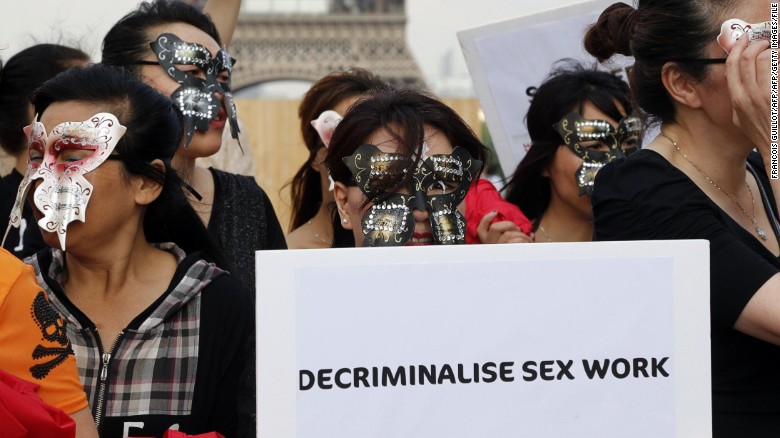
| Amnesty International Votes to Decriminalise Sex Work, Paris, 2015 |
Early this week, I saw a screening
about the documentary film Not My Life a
film made to raise awareness about human trafficking. In that film they showed
much more than just one side of human trafficking. It was also about children,
who were sold and enslaved because of different reasons.
One
of the main reasons was poverty, a systemic issue that might be one source of
inequality all over the world. One
segment of the film was about sex trafficking and it talked about who were the
people who were most at risk. However
one of the lines that most resonated with me was the idea of human trafficked women
and their lack of agency. Later in cla
ss, importantly the idea of who has
agency and assigning agency.
It
is true that women especially that are trafficked and are forced into sex work
do not have agency. They are women that were forced to sell their bodies due to
debts, or were tricked into sex work. However seeing sex work just as forced sex work, or an outcome of
the trafficking of women for sex work and as the victim of structural violence
because of the sex work are the images (although true images) that are not letting sex work being recognized as care work. Laura Maria Agustin writes about this in her
piece Sex in The Margins, the space
where women who cannot move forward if they create their own agency, partly
because of the horrible acts of a human committing to another—human
trafficking.
The
assigning of agency to me, it would seem that one that is assigned by the individuals
themselves. It is a tricky word to talk about throughout topics that have been
heavily divided, as right and wrong and those who can have agency and those do
not. Through the stigma of sex work and the patriarchy and the questions of who
is being exploited, sex workers and their rights will not become recognized as
care work if the stigma and misconception continues. In her writing Agustin herself
asks and the reader how it can still be an issue when so much about sex has
been normalized like strip clubs, peek shows, porn etc. So what really makes the idea of sex work so
abnormal and stigmatized? Is it that the woman is actually choosing to be part
of the care work? Or is it that the person proactively created agency for
herself? Probably a combination of both. Agustin
uses Arlie Hoschild’s theories of emotional labor to prove her point that sex
work is care work. That the individuals that are acting out of their own accord
are doing their own level of emotional and caring work that is needed when they
are being solicited and paid for sex.
Agustin continues, “sex workers often perform their own sexual arousal
and orgasms for clients who feel more excited and gratified if they believe
that workers are, they also act out flirting, counseling, and diplomacy” so sex
work – care work is so much more than just the negative connotations that have
been assigned to it.
In
that sense, for the sex work as care work to become even more forward,
productive and caring to those who are part of the sex industry. I want to
focus in the growing number of young women that are part of it, and also pay
their college tuition with that support. Instead of being sensationalized,
crafted and viewed as a mischievous sex crazed girl but instead as someone who
is designing their own path to pay for education (which the costs now seem to
be unattainable for some). It would be more beneficial for the stigmatization
to end, and to understand that it is not immoral but their own choice. It would
be the time to understand that they have assigned their own agency themselves. By protecting the individuals who are making
these choices through campaigns that work towards the destigmatize of sex work,
and by being recognized by larger groups of sex work advocates would be the
step towards proactive change to make the environment safer for women who are
in that line of care work. In the article that I have attached by VICE the stories of young women are similar in that finding a community and support taught them about their line of work and they did not feel as alienated. Creating these spaces is extremely important.
Just
like Agustin reassured in her piece, sex work and its many components, is care
work. Moving towards a path that accepts this and the agency of women who chose
it, would create a much better environment for the workers. They will feel less
ostracized and the stigma would be removed. At the same time one must not
forget that all of the individuals in sex work might not be in it willingly or
at their own accord. In addition it it is not my intention to diminish their
stories and their struggles. However by creating a much safer environment for
sex workers, unlike France where paying for sex has been banned, perhaps it can
also create opportunities for those who did not go into sex work or care work
at their own accord find support in these spaces where sex work can be free of
stigma. It would open the doors to those who have felt the cold shoulder of society;
it would help the victims that might have not gotten into sex work willingly.
It would be a step forward for those who want their own agency.
Article Referenced:What It's Like to Pay Your Way Through College with Sex Work
Agustín, Laura María. "A World of Services." Sex at the Margins: Migration, Labour Markets and the Rescue Industry. London: Zed, 2007. 53-89. Print.
NotMyLife.org

No comments:
Post a Comment