 |
| google images |
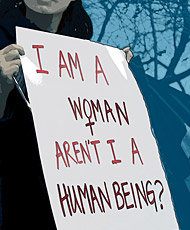
As of April 1, 2016, 6:17PM there are 7,334,771,614 people alive on planet Earth, of which 3,641,491,265 female and 3,693,280,349 male. Roughly half the world’s population is female. There are currently 26 armed conflicts worldwide of which 15 are unchanging and 11 are worsening. What all 26 conflicts have in common is the effect it has on women and their bodily autonomy. Conflicts in the Middle East particularly Iraq involving ISIS, Boko Haram in Nigeria and Democratic Republic of Congo particularly stand out on the world stage for the use of sexual violence against women and young girls. Human Rights Watch and the United Nations have cited/are investigating human rights violations in all three conflicts eliciting vocal outrage from international citizens. In April of 2014 the #bringourgirlsback campaign was launched in response to Boko Haram kidnapping over 271 young school girls. Everyone from First Lady Michelle Obama to Nobel Peace Laureate Malala Yousafzai was involved with the campaign. While the world focused on the sexual violence and human rights violations that was being enacted on women in the global south no one was paying attention to the continued constitutional and human rights violations of the women in the United States concerning women's reproductive health. A woman’s reproductive health is also a human right.
In Chikako Takeshita’s The Global Politics of the IUD she discusses how women particularly Christian women were given misinformation, and intimidated against getting an IUD, a form of contraception, by Dr. John Willke. “‘I tell you, I have seen it again and again through my years as a physician. When we go against nature, sooner or later we pay the price...the womb was made to have only one object inside of it. That object is called a baby...the IUD is a foreign body that just doesn't belong there...’”(Takeshita 116). Willke’s concern for women’s reproductive organs in-terms of the IUD stem from his anti-abortion stance which is influenced by his conservative Christianity, not his medical training. The price Dr.Willke is insinuating is the wrath of God in the form of negative side effects of the IUD, which in his mind and that of other anti-abortionists is the abortion of a child due to the IUD because the IUD prevents a fertilized zygote from implanting in the uterine wall. In debate over whether the IUD was an abortifacient or a contraception the definition of conception was stated as “the implantation of a fertilized ovum” (Takashita 108). With the established definition of what conception is the IUD was medically not an abortifacient. While the IUD was cleared of being a way for women to have an abortion, a larger issue mostly ignored arose from this debate. The decision making surrounding women’s reproductive health did not center around women, their thoughts on the matter, or how their health will be impacted but on men and religion. Roe v. Wade granted women in the United States legalized abortion, however if a woman’s reproductive health was a human right her health-physical, mental and emotional and her opinions will be placed at the center surrounding decisions not men and religion. Placing women at the center of their reproductive health may seem like a far fetched and unattainable feat but it is possible if we re-conceptualize human rights.
To conceptualize women’s reproductive health as human rights, we have to rethink how we view human rights. Susan Okin argues in “Feminism, Women's Human Rights, and Cultural Differences” that human rights were decided by men for men. John Locke and his fellow Enlightenment thinkers were not centering women in their discussions on human rights but men, particularly heterosexual white men. With half the world’s population being left out of the conversation of human rights women did not have a place in the realm of human rights until the post World War II with the 1948 Universal Declaration of Human Rights (UDHR).
The three foundations for International Women’s Human rights: Universal Declaration of Human Rights, The Declaration on the Elimination of Violence Against Women and The Convention on the Elimination of all forms of Discrimination Against Women (CEDAW), does not name a woman’s reproductive health as a human right. All three cover women from gender based violence, discrimination based on sex, language, race, ethnicity, social status and tasks states[governments] to punish those who enact gender based violence against women in the name of human rights. As we all know women are still discriminated against based on gender, race/ethnicity, ability, sexuality and a whole host of other identities. These human rights declarations do not explicitly name women’s reproductive health as a human right, they just scratch the surface of the human rights women need. And needs to have actions set in place in which the continued violation of women's human rights will not be tolerated
The three foundations for International Women’s Human rights: Universal Declaration of Human Rights, The Declaration on the Elimination of Violence Against Women and The Convention on the Elimination of all forms of Discrimination Against Women (CEDAW), does not name a woman’s reproductive health as a human right. All three cover women from gender based violence, discrimination based on sex, language, race, ethnicity, social status and tasks states[governments] to punish those who enact gender based violence against women in the name of human rights. As we all know women are still discriminated against based on gender, race/ethnicity, ability, sexuality and a whole host of other identities. These human rights declarations do not explicitly name women’s reproductive health as a human right, they just scratch the surface of the human rights women need. And needs to have actions set in place in which the continued violation of women's human rights will not be tolerated
 |
| google images |
To be sure laws such as Roe v Wade have given women freedom in their reproductive health, however when states such as Texas can pass arbitrary laws with no scientific backing to close down abortion centers, when politicians threaten to shut down the government to defund Planned Parenthood and when women are being criminalized for having an abortion or miscarriage we need more than laws to protect women. We need human rights because it may come as a shock but women are treated as if they are not humans. Women are seen as incubators for the next generation. With human rights we are one step closer to acknowledging women as not only humans but also as having autonomous control over all aspects of their body including their reproductive health.
Violence against women in any form is wrong, however we should not place the focus of one aspect of violence over another and we should not focus on the violence enacted on one particular group of women over another. It is easy to point the finger and have sympathetic words for women in the global south who are experiencing human rights violations, but we need to do the hard work of looking into our backyard and see that we are also enacting human rights violations on our own population. Amnesty International has launched a campaign My Body, My Rights to inform women of their sexual and reproductive rights which aims to educate women the world over and bring attention to the violations of women's human rights.
References:
Okin, Susan Moller. "Feminism, Women's Human Rights, and Cultural Differences." Hypatia 13, no. 2 (1998): 32-52.
Takeshita, Chikako. The Global Biopolitics of the IUD: How Science Constructs Contraceptive Users and Women's Bodies. Cambridge, MA: MIT, 2012.

No comments:
Post a Comment