| Despite how cute I was and how adorable all babies can be, they aren't for everyone. |
When I was young, I looked forward to the day when I would someday become a mother. Today, I cringe at the thought of bearing children. Whenever someone asks me about motherhood, I say that I love kids but the thought of expelling one from my body is not appealing to me. They usually laugh at my crass and often graphic distinction. Usually, they follow up with “How do you know you won’t change your mind?”, “You say that now, but wait until all your friends have kids”, “Don’t you want to give your parents grandchildren?”, or “You just haven’t met the right guy yet”. My audience is either dismissive or uncomfortable with my conviction. As a young, middle class, white young woman, I am supposed to crave children with every fiber of my being. As I deviate from the script that has been handed to me based on my sex, I am becoming more painfully aware of the societal pressure to conform to this script. This is a distinct manifestation of Foucaultian biopower, the invisible systems and devices that govern women. An essential element of this demonstration of biopower is the widely accepted and perpetuated belief that a woman’s value is dependent upon her capacity to be a mother. Motherhood and childbearing are considered the norm in the United States and are cast as central features of female identity. As Takeshita outlines in her book, The Global Biopolitics of the IUD, many conservative religious and cultural values seek to “contain sexual activity to ‘patriarchally legitimate forms’, which further reinforce heterosexual marriage and motherhood” (p. 115). Thus, patriarchy in our society also plays into the systems of biopower that pressure women to define themselves by their reproductive capacity. Social and cultural messages regarding sex roles, family norms, and even feminism carry implicit and explicit endorsements of women’s responsibility to reproduce (see below) (O’Reilly, 2010). In many ways, our highly patriarchal society creates a narrow and specific lens which colors the ways in which we see women who choose not to have children.

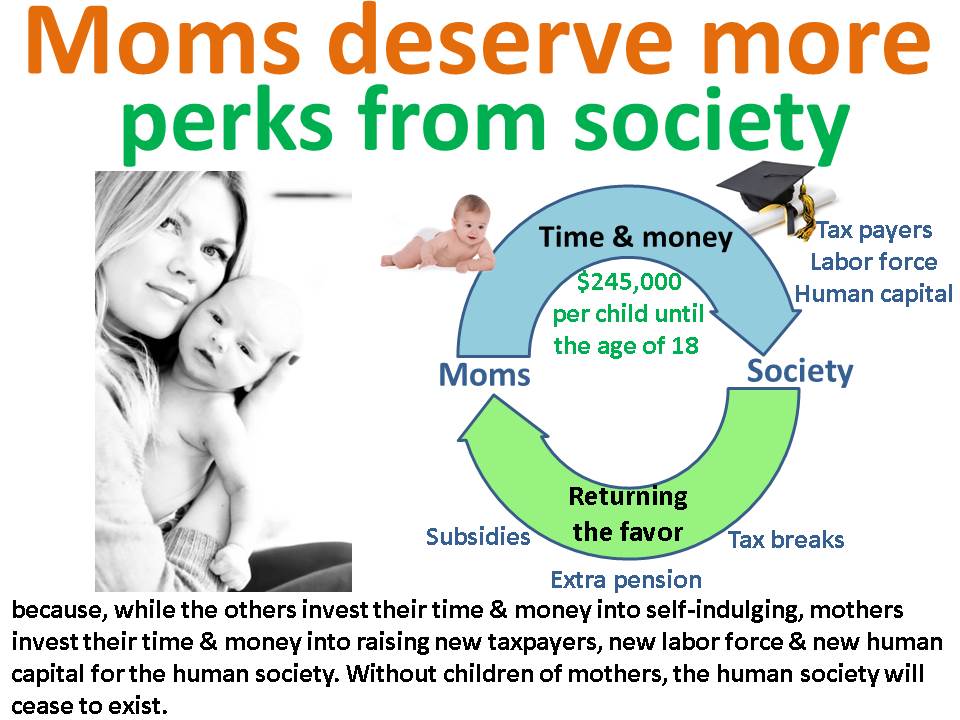
 |
| Examples of pronatalist messaging |
The policy or practice of encouraging the bearing of children is known as pronatalism, and it permeates the lives of countless women across the country. If you fit the desirable model (if you are white, middle class, and of childbearing age), you will be encouraged to reproduce and may be societally punished if you decline to subscribe to this oh-so-appealing option. Women who chose to be nulliparous, or childless, may face attempts at persuasion, disbelief and disdain, and potentially being devalued or dismissed as women. Some may argue that it is impossible to know for sure that you will never want children. Religious women may face resistance to their choice from within the church. Women in public office are often attacked or characterized as barren spinsters, which distracts from their actual political positions. The reproductive status of women trying to move up in politics is made public and used against these women again and again. Pronatalists go as far as to claim that by not procreating, childless women are damaging the future for everyone by causing the global population to decline, which is then of course going to cause disease, war, and economic collapse (Renzetti, 2013). They may also face more tangible harm in various forms. As Takeshita discusses, nulliparous women were historically excluded from consideration and recommendation for IUD use (p. 93-96). Having childless women retain their fertility was considered more important than their access to IUDs. Denying women IUD access was not seen to be as detrimental as the “personal and social implications of a nulliparous woman’s loss of fertility” (p. 94). Additionally, social practices and policies exist which further punish women without children. These include child-friendly policies, such as subsidized family housing, free or subsidized childcare, and the construction of playgrounds and family neighborhoods have been implemented across the United States throughout the 20th century. The United States also offers child tax exemptions (O’Reilly, 2010). Women without children are much less frequently granted flexible work hours than mothers. These forms of pronatalism act as negative reinforcers that encourage voluntarily nulliparous women to have children.
Despite these societal pressures, nulliparity is becoming an increasingly popular and widely defended choice, even being championed by mothers. Movements and online forums to support and connect with other nulliparous women and couples are sprouting and growing. The Childless by Choice Project is a research project, a book, a documentary, and a community that explores and shares the motives and the decision-making process behind the choice of individuals and couples to remain childless. The blog of the community is open to the public and includes a wide variety of narratives of people without kids, the struggles they face, legal activity that affects the community, events for people without children, and general discussion. One post includes a video of Jennifer Aniston puzzling over "why people feel compelled to demand 'When are you having kids?' as if that were the only way a women can contribute as a human being". It seems that more and more of the wider community is actively understanding and confronting the damaging effects of pronatalism. The question now is whether this trend will continue and become powerful enough to challenge the ingrained gender scripts in this country.
Works Cited
O’Reilly, A. (2010). Pronatalism. Encyclopedia of Motherhood, 1(3), 1028. Retrieved March 29, 2016 from https://books.google.com/books?id=UP9yAwAAQBAJ&printsec=frontcover#v=onepage&q&f=false.
Renzetti, E. (2013, May 18). Why childless people are persecuted. The Globe and Mail. Retrieved March 29, 2016 from http://www.theglobeandmail.com/life/parenting/why-childless-people-are-persecuted/article12005541/.
Takeshita, C. (2012). The Global Biopolitics of the IUD: How Science Constructs Contraceptive Users and Women's Bodies. Cambridge, MA: MIT. Print.
Images taken from (in order):
https://pp.vk.me/c628520/v628520598/2d026/17YJ4px5r7Q.jpg
https://pbs.twimg.com/media/CbCEMEoXEAEj6WJ.jpg
https://cdn.slidesharecdn.com/ss_thumbnails/childfree-antinatalist-life-antinatalism-lifestyle-by-choice-breeders-thank-you-for-moral-duty-natal-151129125257-lva1-app6892-thumbnail-3.jpg

No comments:
Post a Comment